
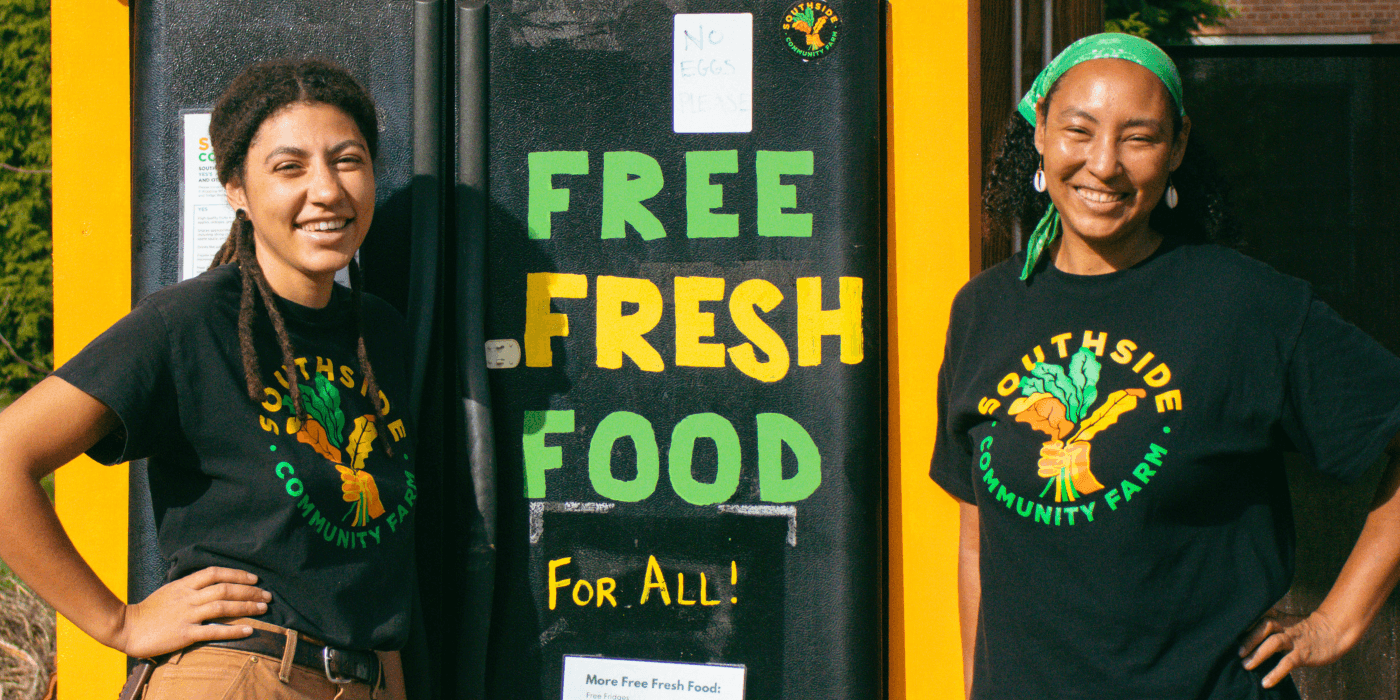
For over a decade now, Southside Community Farm has been sowing seeds, building soil, and deepening roots in Southside, a historically segregated Black neighborhood in Asheville, North Carolina. Its primary plot, an urban greenspace behind a community center, teems with stories and life—including maturing apple trees, excitable children, and rows of produce being grown by and for the community.
In addition to growing culturally significant crops—like okra and collards—the farm is growing Black food sovereignty. This is a place where Black farmers can steward land and community members can define and reclaim control over their own food production, distribution, and consumption. “Our mission is not only to feed people, but to co-create a web of food sovereignty in which community members have tangible power over their local food system,” shares farm manager Chloe Moore.
The farm provides avenues for economic viability, food access, education, climate resilience, reconnection with land, and healing and joy for all ages. During the growing season, Southside operates a popup farmers market at New Belgium Brewing for all BIPOC (Black, Indigenous, and People of Color) vendors—creating more opportunities for farmers and entrepreneurs to build businesses and connect with one another. Feed AVL is Southside’s free Community Supported Agriculture-style veggie box program. Each week 30 to 60 neighborhood families receive weekly boxes filled with fresh food from Southside as well as partnering farms. The boxes also include at least one item from a BIPOC business. The farm hosts ample opportunities for its community to gather, such as monthly BIPOC-centered potlucks, garden days, and Sunday brunches. The farm exists as a learning space, too, hosting a variety of educational workshops and gardening activities for kids.
Until the 1960s, Southside (then called East Riverside) was a bustling Black economic center with 14 grocery stores and dozens of other thriving Black-owned businesses. Due to redlining, rapid gentrification, and Asheville’s urban renewal—the largest project in the Southeastern U.S.—there hasn’t been a grocery store in the neighborhood since 1975. Southside Community Farm was started not just to meet the need for fresh food access, but also in response to a desire for connection, true food sovereignty, and consensual relationships with the land and each other.
Southside Community Farm uses the terms “food apartheid” and “nutritional violence” as opposed to the more common “food desert” to describe the neighborhood. “It’s a racialized system of segregation in which people of color are economically oppressed and their communities artificially removed from healthy food access and any way in which food and nutrition, or lack thereof, are used to enforce existing systems of oppression,” says Chloe. “In order to heal from nutritional violence and food apartheid—in Southside and inflicted upon BIPOC communities in general—we need to focus on community sovereignty. That looks a lot of different ways, but influences everything we are doing. It is food access and food distribution, but beyond that it’s the way we are doing it, consensually. That’s our foundational value.” Food and land sovereignty is both the farm’s biggest goal and toughest challenge.
Growing Leader Farmers
Shuvonda Harper was born and raised in the neighborhood’s public housing and is considered a driving force behind the farm. “I noticed the community was lacking in healthy food access, so when I had opportunity and the access to resources, I knew I had to bring it to the neighborhood,” she says. In 2014, she worked with other neighborhood residents and advocates to form a steering committee to create a growing space behind the historic Arthur R. Edington Career & Education Center. The Housing Authority of the City of Asheville, where Shuvonda worked, along with the now-closed nonprofit Green Opportunities, provided financial and infrastructure support, including connecting the farm to water and electricity.
Over the next decade, the farm grew from a community-led garden effort to a full farm. A community orchard was planted up the block. The farm established a community fridge program and expanded it during COVID as a valuable option for no-contact food access. Full-time staff was hired—including Chloe as farm manager and Kate Wheeler, who now serves as farm administrator and Feed AVL program manager. The grassroots Southside Community Garden grew into the established Southside Community Farm.
Chloe, who has been farming since he was 16 years old and studied sustainable agriculture at Warren Wilson College, calls himself a “landless farmer”—emphasizing the difficulty many young farmers, and particularly BIPOC farmers, have in accessing land. Farm models like Southside can be a way to rethink land ownership and shift the focus onto land stewardship. It also provides a space for a new generation of Black farmers to become leader farmers.
While a multitude of challenges in the Southside community have been exacerbated by disasters like COVID and Hurricane Helene, the farm has been quick to respond to community needs. “Southside has been in a state of emergency for decades with infrastructure, to some degree—already in place to respond to need,” says Chloe. Following the storm, farm staff and volunteers went door to door to make sure residents were not only able to access groceries, but were getting their general needs met, too. In response, they expanded the Feed AVL box program.
In 2024, the farm faced a new roadblock: the possibility of losing its land. Leadership at the Housing Authority had transitioned and didn’t see the same value in a neighborhood farm. A new CEO wrote a resolution proposing to dismantle the farm, saying it did not provide “significant enough” benefit to public housing residents, who make up a majority of the Southside neighborhood. The original handshake agreement between the Housing Authority and the farm was not acknowledged. Chloe, Kate, and other farm advocates rallied the community, which came in droves to support the farm—writing letters, sharing personal testimonies of the farm’s impact, and showing up in person to board meetings. With a new interim CEO now leading the Housing Authority, the threat is on hold for now, but Southside Community Farm still lacks land sovereignty. “While we’re not in the same level of risk at this moment, we’ll always be at risk when there isn’t collective decision-making,” says Chloe.
Hope for a Fruitful Future
One thing that remains at Southside Community Farm is hope. At the end of 2024—even through the uncertainty of their tenancy—the farm hired Lydia Koltai to manage its youth education and community engagement programs. “I’m just really excited to get kids outside in the garden, getting our hands dirty and trying new vegetables. Being able to expand that capacity is exciting,” she says. Shuvonda’s son, who has grown up at the farm since the age of nine, is a living example of the impact of garden education for youth. He recently started a landscaping business with the skills he gained while helping the farm grow.
“My dream is to have a little grocer in the Southside neighborhood again,” says Shuvonda. “A community market with farms and other BIPOC businesses bringing in their goods for sale…that more food will be grown in the community, that we get more years on this property, and that the historic boundaries of Southside may be reclaimed.”
Check out upcoming events, see the dates for the next BIPOC farmers markets at New Belgium, and learn more at southsidecommunitygarden.org.