
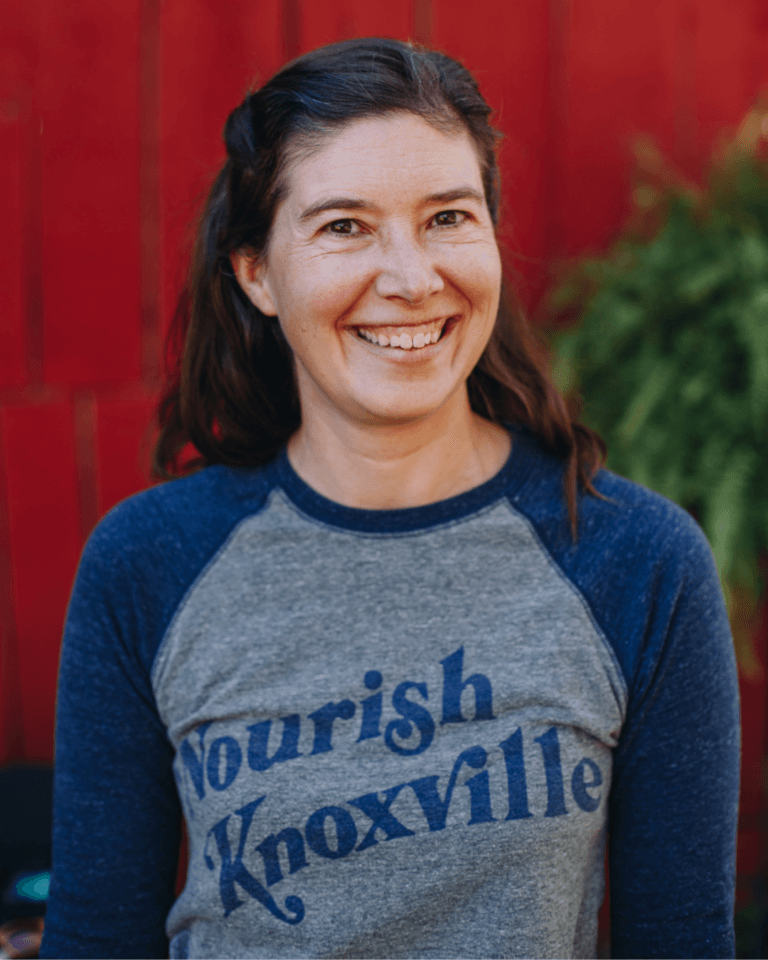
Charlotte Tolley started running the Market Square Farmers Market as a volunteer and over time it became her job. She is now the chief executive officer and a founder of Nourish Knoxville in Knoxville, Tennessee, which operates Market Square Farmers Market and New Harvest Farmers Market; offers community health programs; and publishes the East Tennessee Local Food Guide. Since 2014, Nourish Knoxville has partnered with ASAP to include East Tennessee farm and business data in the online Local Food Guide. With the recent launch of the redesigned appalachiangrown.org, the East Tennessee subsection is easier to navigate with its own landing page and search parameters. Check it out at appalachiangrown.org/nourish-knoxville.
Tell us a little more about yourself and the beginnings of Nourish Knoxville.
I’m from West Tennessee. Various parts of my family farm conventionally. West Tennessee has more row crops like corn and soybeans [than East Tennessee]. I went to the University of Tennessee and found that I really liked Knoxville—I was really interested in historic preservation. I loved Market Square and wanted there to be a farmers market, so I volunteered to help start the Market Square Farmers Market in 2004. The small businesses and restaurants I was working for were starting a development nonprofit and I volunteered to help with the establishment of the farmers market as a part of their efforts.
The actual land for Market Square was deeded to the city of Knoxville by two community members with the stipulation that it be a curb market for farmers forever. They wanted to see the development of a farmers market and the businesses around it. Because of that stipulation, the city had to have a farmers market there or descendants could argue to take that land back. As the lore goes, [that happened] in the ’70s, and the city just sent down some people with vegetables sometimes so they could retain the land. We now have a contract with the city to operate the market there.
With interest in supporting the revitalization of downtown, I started running Market Square Farmers Market. The market initially started (in 2004) under a downtown development organization. If you’re familiar with Knoxville circa 2010–2012 they sort of accomplished their mission of bringing back life to downtown. As that organization started dissolving in 2013, I and a newly formed, local-food loving board of directors established a separate nonprofit—Nourish Knoxville—to operate the market, as well as do more local food and agricultural work across the East Tennessee foodshed.
When did the East Tennessee Local Food Guide start and what was that partnership formation with ASAP like?
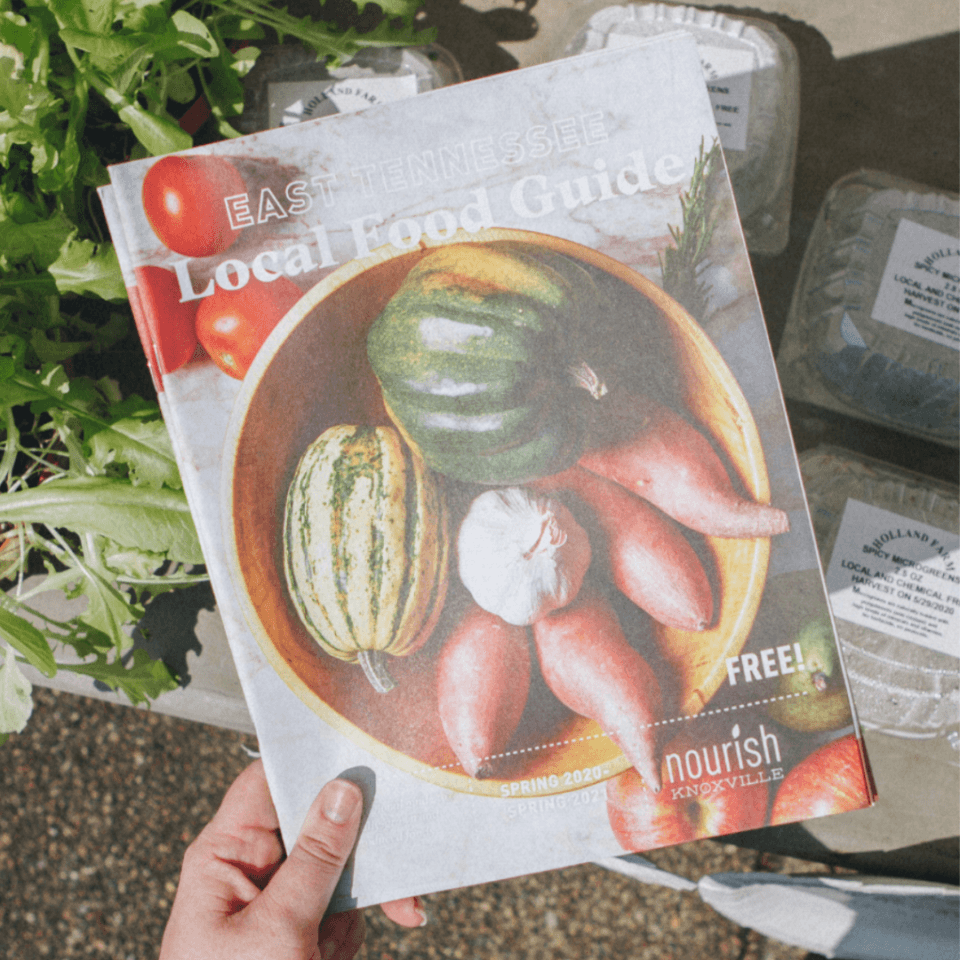
One of the first things that we did as a nonprofit was write and receive a grant through our Metropolitan Planning Commission. They identified connections with local agriculture as a priority. We had already been looking to ASAP as an organization that predates ours, but specifically at the Local Food Guide and local food promotion campaigns. I knew that ASAP already had a database that theoretically covers our geographic region, but it wasn’t as robust. I say a lot that when I don’t have to reinvent the wheel, I’m all for it. So, I reached out to ASAP to see about doing a Local Food Guide in our area. We published our first print Local Food Guide in 2014 and it has grown ever since.
We also work closely with Appalachian Resource Conservation & Development Council in the Johnson City area. I think all of us working together for the common good, sharing data, sharing information—but also as funding waxes and wanes for different organizations—we’re able to support each other to continue the work. I’ve really looked up to ASAP over the last 20 years of our existence.
Can you share more about the farmers market becoming the first in the state to accept SNAP through a scrip system and what that meant for your community?
Around 2008-2009, food stamps were switched to SNAP. Because it went all online, most small farmers were cut out of that revenue stream. Since we were in the center of downtown, the most accessible market by public transportation, and there was not a grocery store downtown, we felt it was important to make all avenues for farm revenue possible, as well as increase accessibility for community members.
It was not easy, but we knew that Sustainable Food Center in Texas had already gone through this process. We inquired about how they submitted their application to their state government. With their help, I submitted our application and it was approved as a pilot program. The technology barriers were still there to set it up as we had to have a phone line to connect our card machine. A downtown storefront helped us make it happen. One of the first people to use SNAP was a farm vendor at our market. They used their SNAP benefits to buy honey and some other things that they didn’t raise themselves.
Using SNAP at farmers markets wasn’t as widely known and we didn’t have a lot of funding to promote it. We started SNAP doubling with a Food Insecurity Nutrition Incentive (FINI) grant. It was a statewide program in Tennessee and Mississippi in 2016. While the farmers market and downtown had grown, being able to offer that match and increase the SNAP dollars as well as the more coordinated outreach was what really escalated usage at the market. In 2019, we took over the management of New Harvest Farmers Market in East Knoxville and provided Double SNAP funding for that as well.
How have you seen the demand and development of Eastern Tennessee foodshed since Market Square Farmers Market opened and Nourish Knoxville formed?
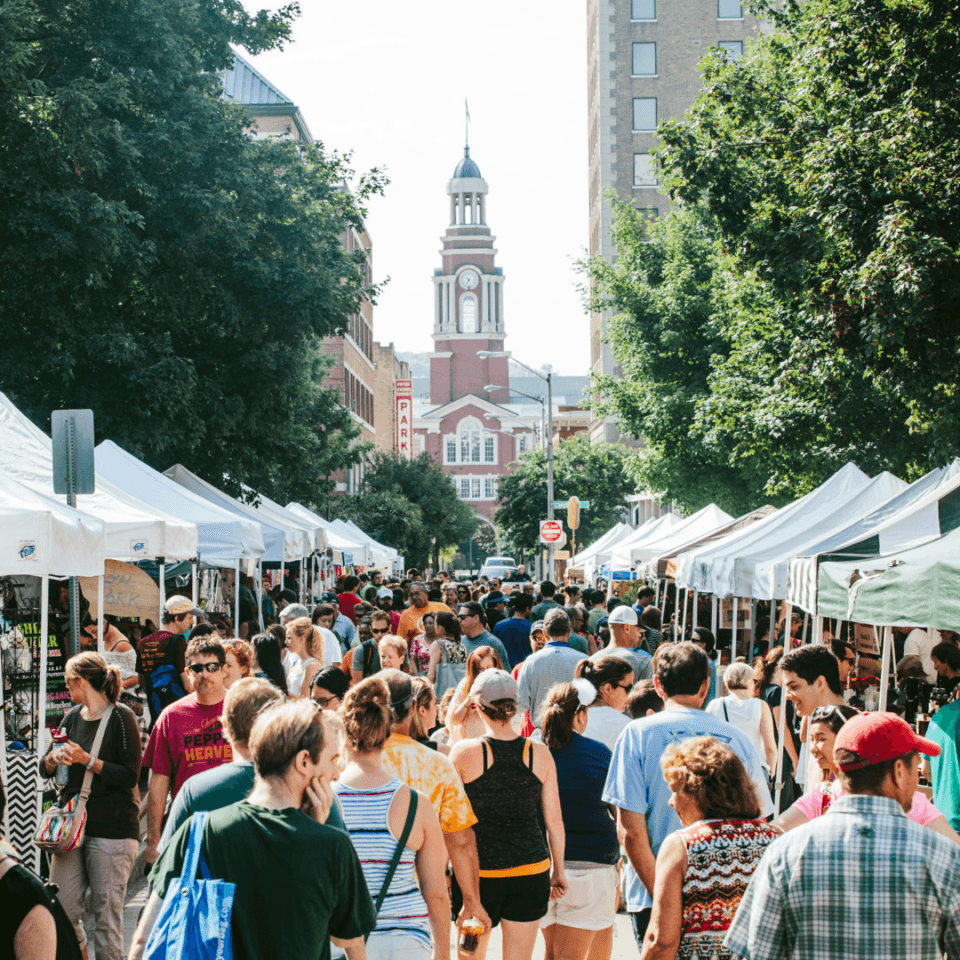
When we opened in 2004 we had quite a few people disappointed by our selection. People would say things like, “Oh, you know, I moved here [from California] and at my farmer’s market we have almonds and plums.” People were kind of expecting us to be a grocery store. For the first five years, the awareness of local food, growing seasons, and what a producer-only farmers markets was wasn’t as much as it is now. Now, people expect producer-only.
The pandemic really affected local food buying because there was more awareness of supporting local farms and smaller groceries—more farmers markets opened, too. Our SNAP usage went way up and people wanted to shop outdoors where they felt safer. We found that a lot of people were rediscovering buying direct from farms. Some of that has held on.
We are also seeing a lot of relocation from the West Coast to East Tennessee, where people are looking for lower cost land to be able to follow their dream of homesteading. People are trying to kind of get back to the land, and it’s producing a bit of a different dynamic in that interest in buying direct.
Do you have a favorite recipe or foods you like to buy/make this time of year?
My specialty is overcommitting to foods, so I just overcommitted to peaches. One of our growers, Mountain Meadows Farm, will do $20 for 20 pounds of seconds. It’s a lot of peaches! I got a deep freezer recently, so this year it’s going to be okay. So right now, the various ways to process and consume peaches.
What’s on the horizon for Nourish Knoxville?
We are working through our own local food campaign. Right now, we have a Farmers Market Promotion Program (FMPP) grant to help us refine our side of the online Local Food Guide and do more specific local food promotion. We’re also really excited that the state of Tennessee has received a Gus Schumacher Nutrition Incentive Program (GusNIP) grant to expand Double SNAP statewide again—this time led by the Department of Health. For a long time, we’ve been working towards working directly with the state government to legitimize and expand this program and it’s coming soon!