

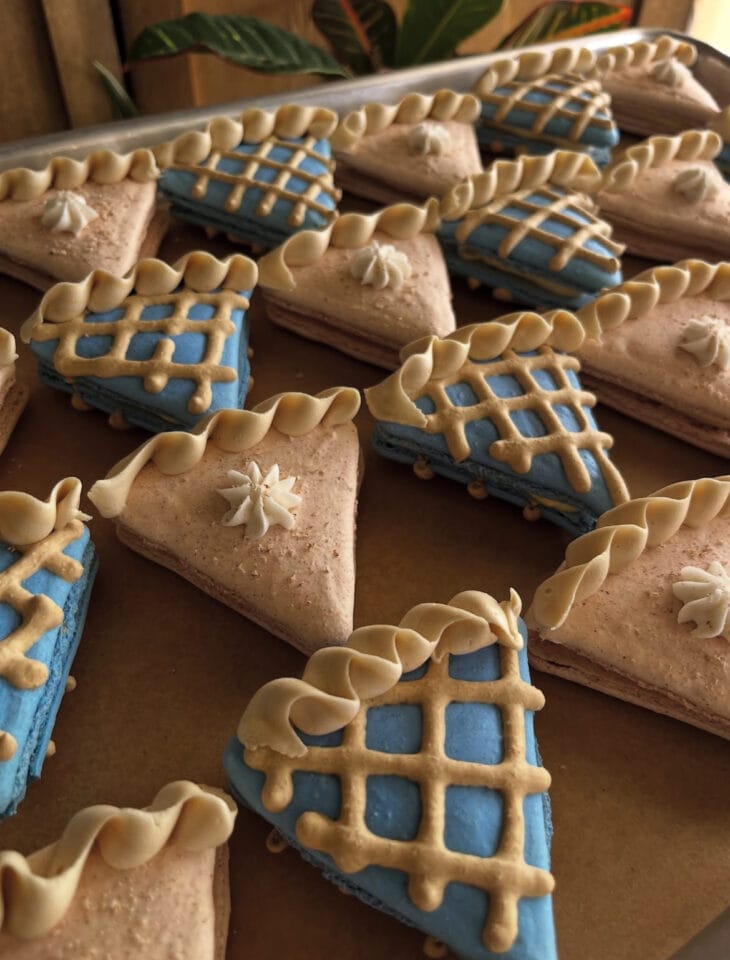
Along with his wife, Jess West, Crawford Rizor has owned and operated beeswax & butter, a micro bakery based in Asheville, North Carolina since 2018. Together they craft delicious baked goods including their classic and fun shaped macarons that can be found at West Asheville, River Arts District, and North Asheville farmers markets. All of their ingredients—eggs, produce, herbs, honey, beeswax, and flour—come from regional producers, most of whom are their fellow market vendors. For the second year, Crawford has joined ASAP’s seasonal team to help fellow local businesses update their information in ASAP’s online and print Local Food Guide.
What is your favorite part of running your local bakery?
I love the way that we run our bakery because it allows us so much freedom in our lives. It’s just the two of us, so we can change things as needed to accommodate our lives—if we are sick, if there is a snow day, or a disaster like Helene, where we are all affected by the same thing, for example. Because we have close relationships and great two-way communication with all the people whom we do business with, we have that flexibility and understanding when things change. It’s very personal—we refer to our vendors by their names, not by their business names or products. The same is true of our customers. I love having that level of interconnectedness in everything we do.
That interconnection thread shows up in our food stream as well. All of the local ingredients we source from markets stay within the local food system. Everything we produce is going back out into the market where we got those ingredients, back to the mill where we get our flour from, and out to restaurants where we know those folks are serving people who live here. I’m grateful for that reinforcement of a local economy and local food stream.
What value do you see in sourcing local ingredients for your products?
Beyond the personal connection, I value that reinforcement of the local food economy and the infrastructure that supports farmers, producers, and consumers. I can’t stress the importance of that enough, especially after we have seen how easy it is to disrupt the supply chain nationally and even regionally. I love when I’m vending at market and I can see the progression of the season through what’s available. We want to keep refining our products to incorporate what’s available to us. Now I know when to buy something, who to buy it from and when it’s going to be at its best. Being in tune with seasonality also helps me make sure I am waiting long enough that there is enough of a certain crop that the price may be better because the producer may have more than they can offload.
What kind of role does beeswax & butter play in our local food system?
It’s another opportunity to showcase and bring attention to the foods that are being procured by others in the area. There are foods that are native to this region, and that context is important. There are foods that may not be native, but still have a rich and long history in the region, like apples and peaches. While neither of those are native foods, they still have a strong history that pervades the culture in ways that may not be immediately apparent. For someone who grew up around here, they hold a lot of memories of eating the perfect peach at the height of summer. I think being able to talk to consumers about those things is another way to keep that history alive.
Additionally, while we process and freeze a lot to use later, we do use most of our products when they are in season. I love the opportunity to talk to people at markets and share little tidbits about that particular crop. The ones that come up the most are the ones that are less common, like pawpaw. I have a whole spiel for that because most don’t know what they are. So, when we use them in our pastries it’s an opportunity for folks to learn about what that is, the significance of it in native cultures, and how the fruit may have been eaten. I want to be a part of passing that knowledge down, especially when they aren’t typically western foods. I love being able to turn people onto a new food.
Headed into your second year as a Local Food Guide caller, what are some takeaways on the value of being in the Local Food Guide as a small business?
I now know to share that resource with other people and make sure they know it’s a resource available to them. Recently, I had a friend looking for wholesale eggs at a time when the egg producers are ramping down, and they were able to find someone same-day through the Local Food Guide. If I’m looking for something specific I know I can use the online and print guide to find what’s available in our area.
Having a listing is a really low-entry and low-cost way of getting business. I can’t think of another ad system that would be at the same price point of being in the print guide, and obviously having an online listing at appalachiangrown.org is free. For the low amount of effort that goes into it, it’s a really easy decision to make—to be seen by thousands of consumers and local businesses. People who are picking up the guide are already values-aligned in supporting local food. They might be looking for a restaurant or business who has a specific item, so you already know you are starting at a place that has that shared value in local food. It really brings everyone together.m which affects the apple crop. With all the rain, it’s hard to maintain the disease levels, too.