
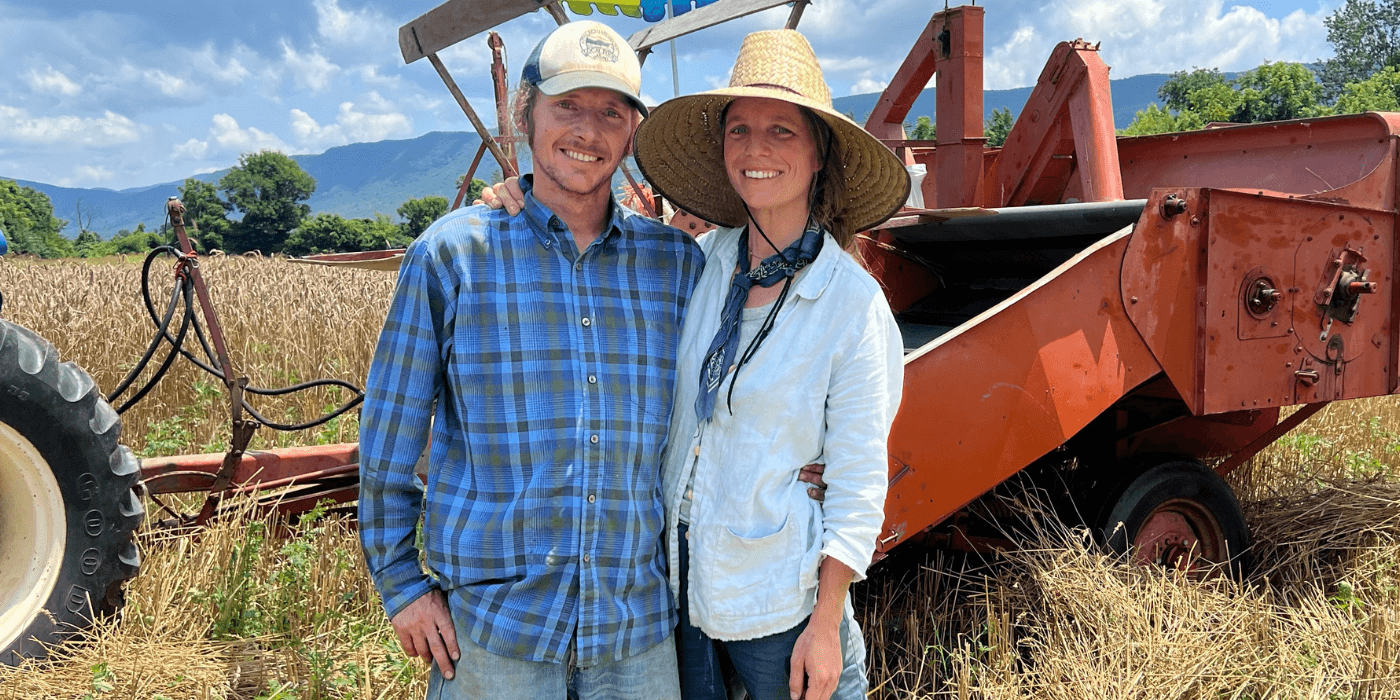
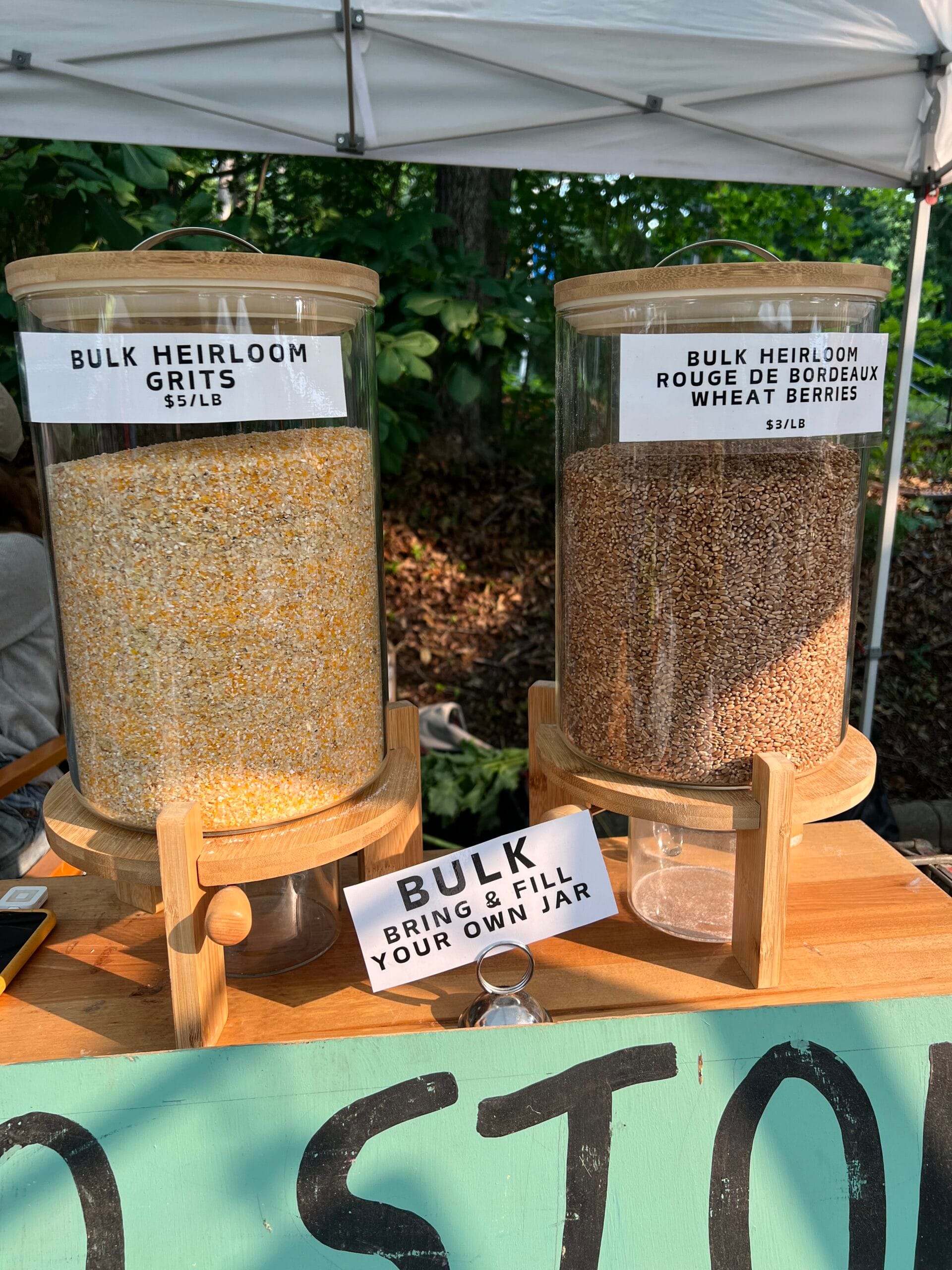
Duane Gibson and Lindsey Giglio are co-owners of Two Stones Farm + Mill in Greenville, Tennessee. Just a few miles from the North Carolina border, they are growing grains like corn and wheat along with classic summer fruits like blueberries, watermelon, cantaloupe, and more. Two Stones is participating in Appalachian Farms Feeding Families, one of ASAP’s post-Helene programs aimed at supporting restaurants and strengthening market outlets for farms. They are paired with OWL Bakery, and will be providing employees with CSA shares. Find Two Stones at West Asheville and North Asheville tailgate markets and their milled products at local stores and small grocers across Western North Carolina.
Share more about the origins of Two Stones Farm + Mill.
Duane: My family had a blueberry propagation operation and helped kick off the Georgia blueberry bloom in the mid ’70s. The farm started when my folks moved up from Augusta, Georgia to Greenville, Tennessee in the ’80s. We kept bees, chickens, and horses, but we didn’t really farm the land at first, just leased it out. As a homeschool project, I planted our (now) older blueberry patch. In 2010, a tornado came through. It was emotional and destroyed a lot of the farm. It’s kind of what we’re going through now post-Helene. After that, most of my family moved to Alaska. All the large trees were gone, the two barns and the bees were gone. I was doing massage in Asheville during that time and asked my family not to sell the farm, but to lease it to me. That’s when we really started tending to the patch and investing in the land. I met Lindsey about 6 years ago, in 2019. Her being a miller and baker convinced me to be a grain farmer, too.
What is driving y’all to local grain production?
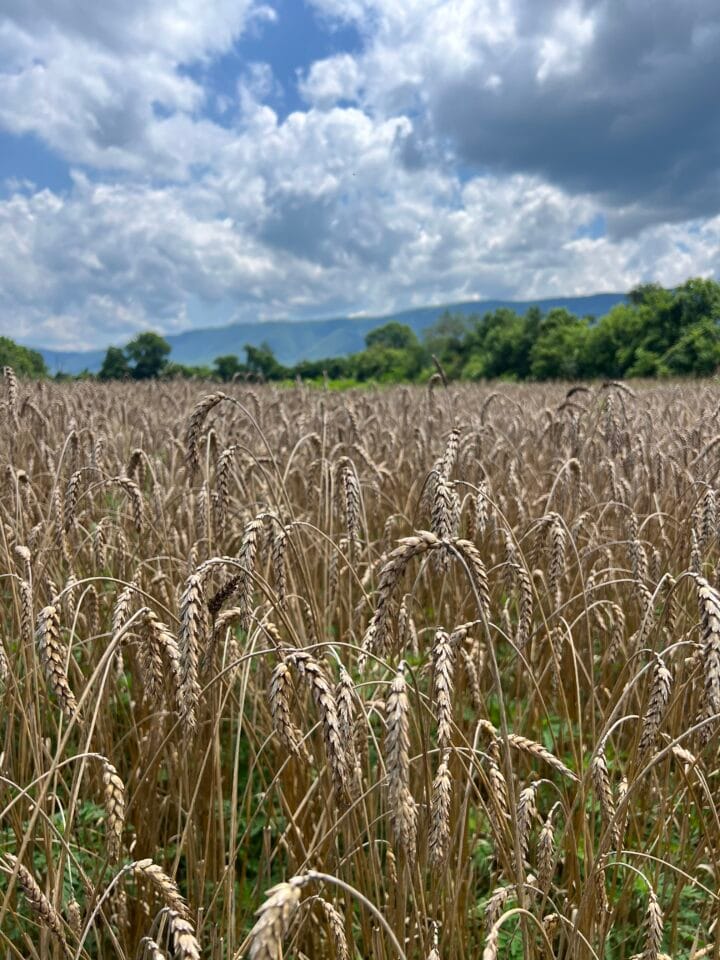
Lindsey: When Duane and I met, I was baking at OWL and milling for Farm & Sparrow. We both told each other that we want to grow grains. We started dating and our passions seemed to align—blueberries and grains. If you look at the whole system, why are so many people having problems around wheat specifically and who’s going to change it at a local level? That’s the question we asked ourselves and what brought us to grain growing and milling. It’s challenging to grow wheat in the south but we really like bread and we want to keep that as something that people can have in their diets.
Duane: I am actually gluten sensitive. When the tornado came through the farm, I lost so much weight just eating survivor food and was sent into a mental, physical, and emotional crisis. I made it two weeks before I got really sick and that’s one of the reasons I’m a farmer. Grains are a staple food, something that communities can subsist on. We find that organic or low-sprayed grain isn’t really being grown in our community. Most markets are pretty fruit and veggie forward, especially for the Asheville market and for the restaurants. For us it’s more than just growing and milling. We want to build community around it, like having a bakery and having pizza nights out here at the farm.
Lindsey: It’s all about the connection of food and how we feel connected to each other. The idea is if you go to the market, you can get everything you need—your milk, your eggs, your produce. Once people start seeing wheat as a plant, it shifts your mind completely. It’s not just a commodity—this massive, lifeless aspect that is a huge part of everyone’s diet. It is bread that is one of the best parts of life, especially with strangers. Anywhere in the world, bread ties people together. It feels special to be a part of that and show people more of where and what bread comes from.
Duane: Wheat is one of the few crops where you start with a handful of seeds, then in a few years you have more than you know what to do with! The sheer abundance this crop grows is amazing. As our society has become more industrial and city-driven, we have forgotten what our parents and maybe grandparents used to do in terms of farming and subsistence. We are not doing anything new, but we are reminding people what is still happening and making it available locally.
Lindsey: When Helene happened, or in 2020, no one could get flour. People needed to sustain. What do you get when a tragedy happens? Milk and bread. If we had all the grain to provide our community, we wouldn’t give into the scarcity mindset. We are imagining that if we have enough grain here that our local community is going to be set if something happens. If more people support that now, then we can grow the infrastructure faster. We want to get back to localized food systems, localizing bread as it has been for thousands of years. We can’t let bread ruin us now! We need to take that power back.
How has ASAP’s programming supported your business and ability to farm?
Duane: As a farmer, ASAP’s Business Farming Conference gave me the chance to keep learning and be surrounded by amazing peers, who some are now mentors. It’s connected me to the greater farming community. Over time, the ASAP’s Appalachian Grown branding works within the ecosystem of Appalachia, people recognize it and helps them feel more trusting of their farmers and food sources. As a Tennessee farmer, ASAP has benefited the East Tennessee area. Greenville and Greene County often get lost. It’s more rural, and I’m grateful to live in South Greene which is very close to the NC border, but I’m not in the Johnson City or Knoxville markets. ASAP helped me feel more a part of the Southern Appalachian region. By ASAP having all the infrastructure, ASAP really helped post Helene.
Lindsey: ASAP is great with making it work for the farmer. Recent funding with Helene and even getting emails letting us know it’s going to be okay and information about where other outlets are were super helpful. Now, with the Appalachian Farms Feeding Families mini-grant with the restaurants, we are working with restaurants and bakeries who already support us. OWL and their staff are going to benefit by getting our produce as CSAs. It supports us when we are in a time of deep funding cuts, and it’s a marketing aspect because now the employees of OWL know us and where to find us. There is the educational aspect, too. Farmers do so much, so to have the educational aspect relieved a little bit is great. We give recipes out, but ASAP having recipes and activities for kids at markets, Double SNAP—everyone is benefitting.