
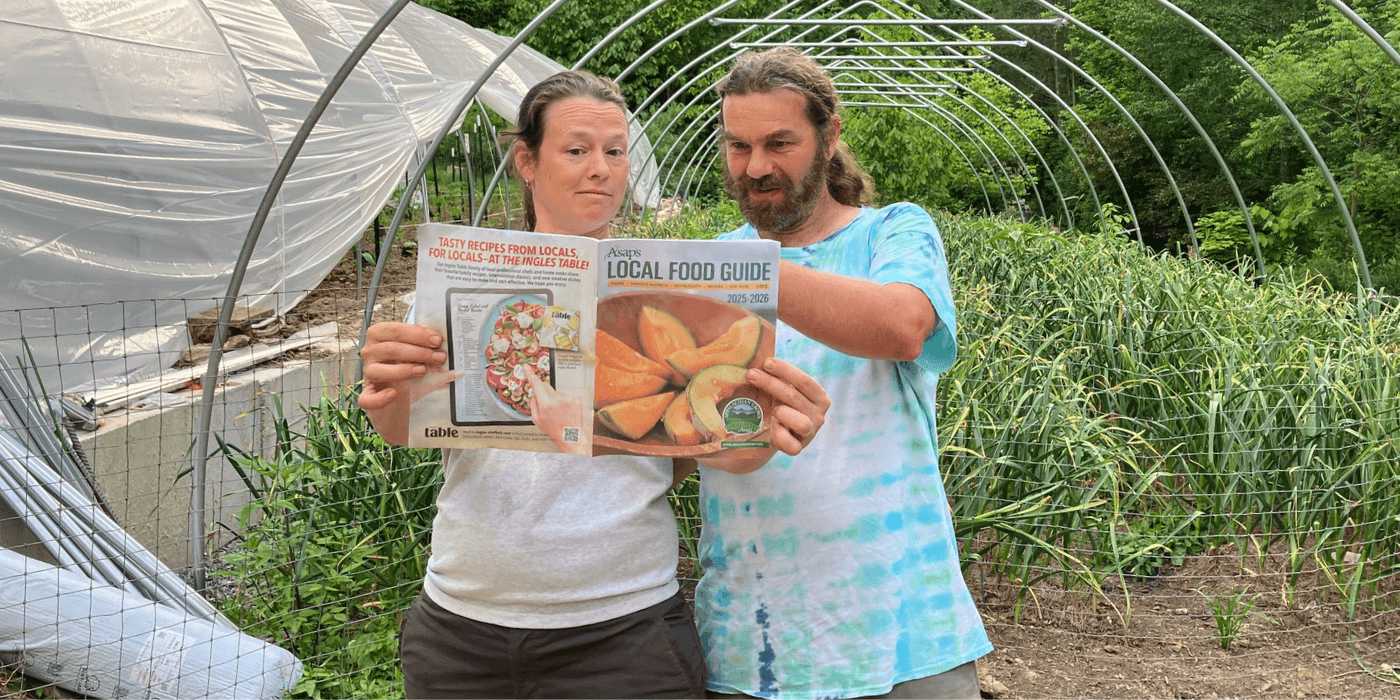
“We were standing on our front porch—my daughter, my husband, and I—and there was a landslide,” recalls Sara Martin, co-owner of Two Trees Farm and Sustainabillies, a small farm, metalworking, and homestead education business nestled on a mountainside in Haywood County, North Carolina. “We watched all of our hard work get buried by a tidal wave of mud. We had to grab what we could and run for our lives. We hid in a barn for eight hours, not knowing if our house would still be here. After that was all done, we just didn’t know what we would do.”
On Sept. 27, 2024, Hurricane Helene tore through Southern Appalachia. Record-breaking rainfall flooded rivers to levels beyond the thousand-year floodplain projections and generated landslides that swept away mountainsides. In addition to the loss of life, the destruction was catastrophic for local communities. Thousands of homes and businesses were damaged, roadways were washed away, more than a quarter of the region’s trees were destroyed or damaged, and millions of people lost access to critical services like water, sewer, electricity, telecommunications, and healthcare facilities. The impact was especially devastating for farmers whose livelihoods are intrinsically connected to the land and waterways.
Many were left like Sara and her husband, Dustin Cornelison: reckoning with mountains of mud and debris; staring down giant boulders with no equipment to move them; or wondering if their topsoil or water sources were now contaminated. Luckily for Sara and Dustin, their house was spared, but the landslide covered nearly half the farm. “We lost our 15-year-old blueberries, terraced vegetable production area, a greenhouse, raspberries, and thousands of dollars worth of produce,” Sara tabulates.
“We’re basically starting from scratch after 24 years,” says Nicole DelCogliano, who co-owns Green Toe Ground Farm in Yancey County with her husband, Gaelan Corozine. Their farm was swept away by the South Toe River—including six acres of vegetable fields, high tunnels, barns, tractor, pack shed, cooler, wash stand, irrigation system, hand tools, and more.
Physical damage varied widely, but nearly all farms in the region were impacted by the storm. Surveys by ASAP’s Local Food Research Center in the months following the storm found that 86 percent of Appalachian Grown farms reported some level of damage, including crop and animal loss as well as damaged infrastructure and equipment. But all farms, even those with no physical damage, lost significant income due to restaurant closures, stalled tourism, and economic hardship throughout the community. ASAP estimates lost sales for approximately 900 Appalachian Grown farms—primarily small, direct-market farms—to be $24.5 million. The cost of clean up and rebuilding is estimated at an additional $30 million. Broadened to include all farms in the region, the financial impact is more than 10 times that.
“I don’t think we understand the deeper level of change—both in our community as well as our ecosystem,” says Nicole of Green Toe Ground. “For example, we built two new high tunnels. Water was pooling in one corner. We realized the soil compaction is different because of weight of flood water. We have to relearn that. We lost more trees, so the river is impacted. It’s one thing to think about soil health, but it’s the whole ecosystem. I don’t think we know yet what all that will look like.”
Relationship to Risk
Farming the French Broad River region of the Southern Appalachians has always been challenging. A land of fertile and loamy river valleys and craggy inhospitable highlands, the landscape plays the biggest role in determining suitable farming locations. As a result, the majority of farms are confined to small parcels in low-lying river valleys and are highly susceptible to flooding. For many of these farms, insurance options are cost prohibitive and often don’t fit a diversified farm model selling niche, non-commodity products.
“We have a healthy relationship with risk,” say Ed Graves and K.P. Whaley of Tiny Bridge Farm in Henderson County. Their farm flooded during Tropical Storm Fred in 2021 and again from Helene, destroying all of their fall crops and two hoop houses, as well as damaging the walk-in cooler.
Though Tiny Bridge’s farmers are now familiar with the ins and outs of applying for aid—including through insurance, FEMA, and multiple programs of the United States Department of Agriculture (USDA)—navigating these programs is daunting and frustrating for many farmers. “Applying for all the things has been a full-time job,” Ed and K.P. say, noting that much of their support has come from local or regional organizations.
State and federal disaster relief funds can be slow moving or exclude small farms. Community-based organizations, such as ASAP, were able to react more quickly after the storm and connect directly with farmers to help with immediate needs. “ASAP reached out and put us in touch with granting organizations and helped us find resources,” says Sara. “We were able to get several small grants to make sure we could still put food on our table.” Farmers, like many families and small businesses, also found assistance through crowdfunding and mutual aid, as well as volunteers who showed up to help with cleanup and rebuilding.
Even where farms do qualify for state or federal assistance, crop loss reimbursement programs are typically based on wholesale commodity prices. The small-scale, diversified farms in the Southern Appalachian region depend on lower-volume, high-value market outlets to sustain their farm businesses—places like the farmers markets, farm stands, and restaurants highlighted in this guide. Crop losses end up being significantly undervalued.
Two Stones Farm and Mill, located just over the Tennessee border in Greene County, specializes in stoneground heirloom cornmeal and grits, which they sell to Asheville-area restaurants and other direct markets at $275 per bushel. Farm Service Agency (FSA), a division of the USDA, valued the crop at $4.01 per bushel based on the current price of field corn. Two Stones lost 10,000 pounds of corn due to storm impacts—over half of their farm’s annual income that is not covered by insurance.
Waiting for Help
Waiting for cash flow from state and federal agencies can also cost farmers precious time, especially as recovery creeps into the planting window for next season. “Because we did work with FSA, we had to wait,” says Sara of Two Trees. “In order to get reimbursement for your expenses, you’re not allowed to do anything until they have evaluated the situation. It took about two months to get the green light. And then it got cold. The ground froze. If we’d been able to clear and rebuild sooner, we could have made $5,000 through the winter.” Income is a huge source of stress for farm businesses, which operate with thin margins even in good years.
Two Trees’ lost blueberries qualified for FSA’s Tree Assistance Program, but were ultimately valued at $147—as opposed to the more than $800 cost to replace them. They were preapproved for $14,000 to rebuild the terraces and greenhouse, Sara says, “but with this kind of math, I’m not sure what we’ll get.” As of spring, their reimbursement money from FSA was on hold again, requiring additional forms and inspection. “We just have to move forward,” says Sara. “We have to be able to make a living off the farm.”
Alongside friends, neighbors, and volunteers, Sara and Dustin have started to move the deposited earth, distributing it around the farm since they don’t have the financial means to have it trucked away. They installed giant cement blocks, supported through Empowering Mountain Food Systems, to fortify new terraces. They spread out seven cubic yards of compost provided by Mother Earth Produce—another key connection, as Sara notes it’s nearly impossible to find any organic compost in Western North Carolina post storm.
With a new greenhouse up and running, Sara and Dustin have been able to sell plant starts and produce at spring farmers markets and festivals. They’re pointing out how rebuilding will allow them to scale up farm production and work more efficiently—something Nicole of Green Toe Ground also notes.
“It’s a strange opportunity that was forced upon us,” says Nicole. “We have more knowledge and experience and we’re hoping we can rebuild in a way that’s more succinct and designed to work for us for the longer term. It’s still really daunting. But we’re proud of what we’re doing.”
“We have real joy when we step out our front door again,” says Sara.
Find additional post-storm reporting from ASAP’s Local Food Research Center at asapconnections.org/local-food-research-center.