
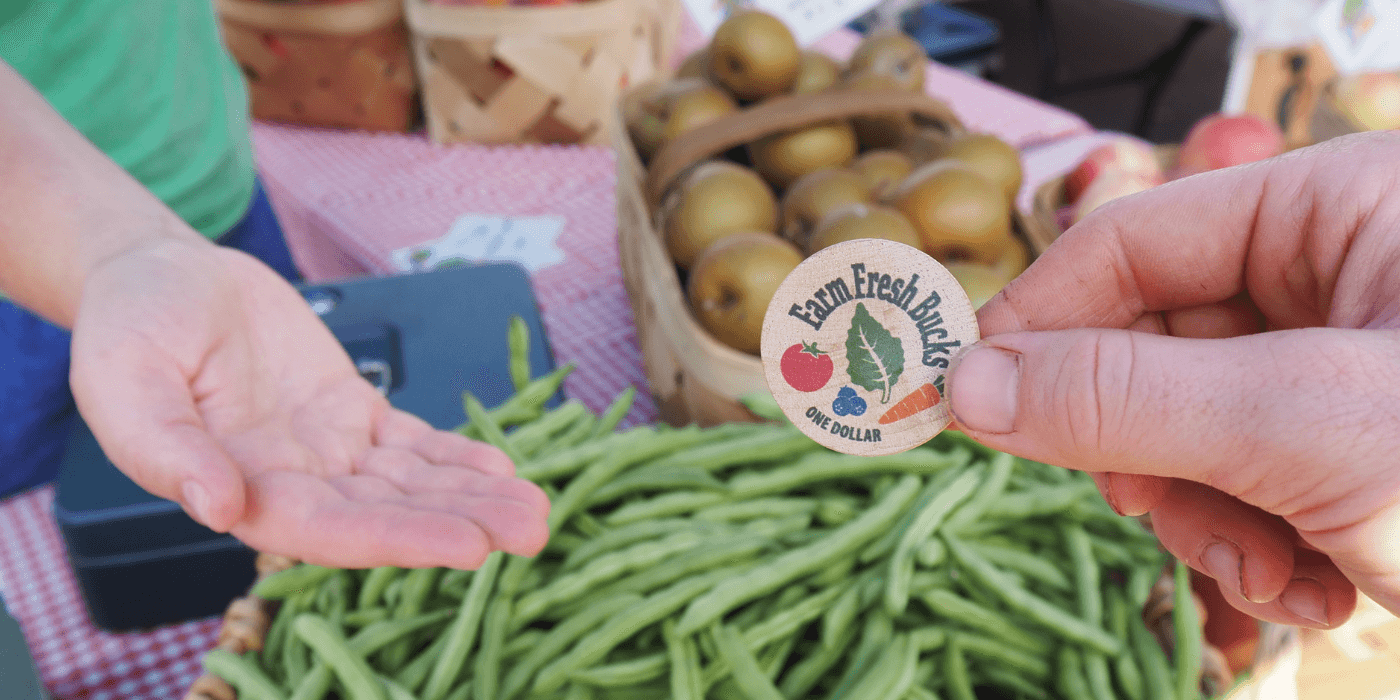
Visit a farmers market in Southern Appalachia and you might be delightfully surprised to find that market accepting Supplemental Nutrition Assistance Program (SNAP) and offering incentive programs that double those benefits for shoppers. Access to fresh, healthy, and locally grown food is a cornerstone of a thriving community, but there are still a multitude of barriers to making local food the easy choice. Incentive programs like ASAP’s Double SNAP for Fruits and Vegetables are growing at farmers markets nationally, making it easier for community members to purchase fresh, local produce.
For generations, farmers markets have served as more than just a place to buy fresh food and locally made goods—they act as hubs for communities to connect, gather, and share information. They foster economic activity and outlets for farmers and small businesses, and they provide educational and relational opportunities for folks to better understand where their food comes from and how it’s grown.
Pioneers of SNAP Access
These days, there are dozens of farmers markets in the region where shoppers can use their EBT/SNAP benefits to purchase locally produced foods, but that hasn’t always been the case. In 2008, ASAP’s Asheville City Market became the first farmers market in Western North Carolina to apply for a Food and Nutrition Services (FNS) account to accept SNAP. This was a first step in increasing access.
Because Asheville City Market is a program of ASAP, it has often served as an incubator space to test new programs that benefit both farmers and consumers. As more markets in the region began seeking support around SNAP access, ASAP and Asheville City Market were able to serve as consultants, coaching interested markets through the process. A further benefit of Introducing SNAP/EBT technology meant that markets could now more easily accept debit and credit, significantly increasing vendor sales and making local food shopping more convenient for consumers.
“I get satisfaction in realizing that ASAP, and Western North Carolina in general, is kind of a pioneer of SNAP access at markets in the region,” says Mike McCreary, who previously served as Asheville City Market’s manager and now directs for ASAP’s farmers market programs. He has been stewarding this process since 2009. “Accepting SNAP at farmers markets widens the market community, fosters health improvements, and helps to sustain farmers.”
Having the tools and technology to accept SNAP at farmers markets was not the only barrier to increasing access. Many community members had never been to a farmers market and didn’t know if they would feel welcome. Offering SNAP doubling programs was one way to encourage new shoppers to visit the market. Mills River Farmers Market in Henderson County was one of the first markets in the region to offer a SNAP incentive, in 2015, followed by markets in Haywood and Watauga counties in 2017 and Asheville City Market in 2019. Access programs at markets also included WIC, Senior Nutrition, and, more recently, produce prescriptions.
To both sustain and expand these community-led efforts, ASAP partnered with Blue Ridge Women in Agriculture and MountainWise to form the WNC Double SNAP Network and apply for federal funding to deepen and expand SNAP incentive programs. With support from the USDA’s Gus Schumacher Nutrition Incentive Program and leveraging matching funds, the number of participating markets has grown to more than 30 sites. In 2024, the WNC Double SNAP Network doubled more than $400,000 in SNAP sales.
Dual-Benefit Programs
Sydney Blume, who manages farmers markets and the Double Up Food Bucks program for Blue Ridge Women in Agriculture, loves that these programs support a mutual relationship between farmers and customers. “For farmers, they are able to feed people, and this Double SNAP helps them make more affordable decisions for customers. For customers, it’s better for their budget and matches their values too, so they can support their farmers and be a deeper part of the community at markets,” she says.
Small farmers experience higher overhead cost and need to focus on higher-value items instead of higher volumes to meet economies of scale. Dual-benefit programs like Double SNAP allow farmers to get the price that they set for their business model and consumers to be able to access fresh local food. For farmers like Anna Littman of Ivy Creek Family Farm in Barnardsville, NC, SNAP incentive programs have made it possible to bring farm employees’ pay to a livable wage, while ensuring that she’s not pricing out the customers who need access to fresh, healthy food.
For SNAP customers, being able to shop at farmers markets and participate through incentive programs has been a game changer. Through customer surveys, shoppers have shared how these programs positively impact their lives, their health outcomes, their social connectivity, and their ability to feed themselves in ways that align with their values. Many report they wouldn’t be able to shop at farmers markets without these programs. “I think buying local meat and produce tends to feel like a luxury,” says one shopper. “Being able to buy our produce at the farmers market with our EBT funds has 1) given us opportunities for an outing with our kids that gets them excited about picking out healthy food with us, 2) made us feel more connected with our community, and 3) offered a sense of dignity while shopping with food stamps—there’s not just no judgment, but encouragement with Double Up to use food stamps locally.”
In the aftermath of Hurricane Helene in fall of 2024, many residents qualified for emergency Disaster SNAP (D-SNAP) benefits to replace spoiled or lost food. Because SNAP and incentive programs were already set up at dozens of farmers markets in the region, more customers were able to stretch their food dollars within their own community. Farmers were able to sell more fresh produce after having lost sales at multiple restaurant and retail outlets. Many markets reported an uptick in SNAP sales in the fall. Having SNAP programs at markets not only made the region more resilient and prepared to handle the aftermath of a shared disaster, but reinforced the role of farmers markets as essential food distribution and community centers during times of crisis.
Find farmers markets offering SNAP and learn more about ASAP’s SNAP programs at asapconnections.org/snap.